History of the Combo & The Wise Addition to Boiling Springs

Last edited March 14, 2021

I recently posted the picture below of the former “Combo” in Boiling Springs to a Facebook Group of which I am a member. It generated much commentary and several unanswered questions. Curiosity got the better of me and I took off on another road trip into history looking for answers.

image

For Sale advertisement on page 26 of the July 31, 1948 Harrisburg newspaper “The Evening News”

Prior to 1923 all the land on the east side of Forge Road across from the Iron Forge Educational Complex, from Springville Road to Gerald Putt’s log studio, was farmland owned by William Arnold and his wife.

The Arnold’s house is located on the southeast corner of the intersection of Springville and Forge Roads. Some older residents may remember Mrs. Arnold’s little store that set next to the house. Others may remember it as the site of the Canary Drive-In, the Bubble Drive-In, or Benny’s Pizza as it is today.

In March of that year (1923), Mr. and Mrs. Arnold sold the strip of land next to Forge Road to L. Floyd Hess and his wife Mabel, who had the property surveyed and divided into a development plan containing 24 lots. (See the plot plan at the top of the page.)

[NOTE: While the newspaper advertisement indicates that “The location is on the Carlisle Pike …”, it was actually on a street called “Carlisle Avenue” which ran parallel to a State Highway (now Forge Road) with the Valley Railways Company’s trolley tracks and right of way separating the two.]

That August a company named Sunni Glo Gardens, Inc. bought lots 22, 23 and 24. While I did not conduct an extensive search I could find no records as to what Sunni Glo Gardens did with the land, but they owned the orchard on what was known as Persimmon Hill (now Allenberry Hill). Four years later, on February 28, 1927 the company sold the property back to Mr. and Mrs. Hess. There was no mention of any buildings in the deed.

On the last day of August 1940 Paul Wise and his wife Pearl bought lots 22, 23 and 24. In a comment on the post, Paul and Pearl’s daughter Pat Wise Strickler recalled “My father, Paul Wise had the Combo built; my mother operated the milk bar, my brother and I pumped gas, the middle room was a display room for my fathers Lenox heating units.” When asked about what year it was built, she said “My guess is 1946-7, after he … returned home from serving his country in the War.”

As to the origin of the name, Pat Strickler and several other long time residents remember that there was a contest to come up with a name. Pat says “ As for the name; my parents had a contest and I believe John Riggs suggested it be called the Combo, because of combination of businesses. The prize .. a portable radio, if my memory serves me correctly.”

The Combo, as advertised above, was sold to Dale Fetrow in April of 1951 and was leased and operated for a time by a couple named Dennison who Pat Strickler believes were from Nevada. In January of 1952 a domestic transfer was made from Dale to Dale and his wife Genevieve. Three years later in March of 1955, in another domestic transfer, it was sold by Dale and Genevieve to Genevieve alone. During these years Genevieve Fetrow is remembered as working the restaurant as well.

In August of 1957 Genevieve Fetrow, a single woman, sold the establishment to Emory and Elmira “Mom & Pop” McDilda who operated it for the next 11 years. The McDilda era ended on June 10, 1968 when they sold the house, restaurant, showroom and lubrication room to Ray and Ethel Myers.

image

A picture of Lorraine Negley and others inside the Combo from the 1958 Bubbler Yearbook.

Six months later Mr. and Mrs. Myers sold the property to DD&M Corporation (Dallas, Davis & Myers) .

DD&M purchased an adjoining tract from the Boiling Springs Development Company (Dr. Davis, President) , and proceeded to demolish the Combo and construct the bank/food-mart/gas station building that exists today.

Author’s Note: If anyone has additional verifiable information or pictures that you would be willing to share for future updates of this article please let me know.

Last edited March 14, 2021
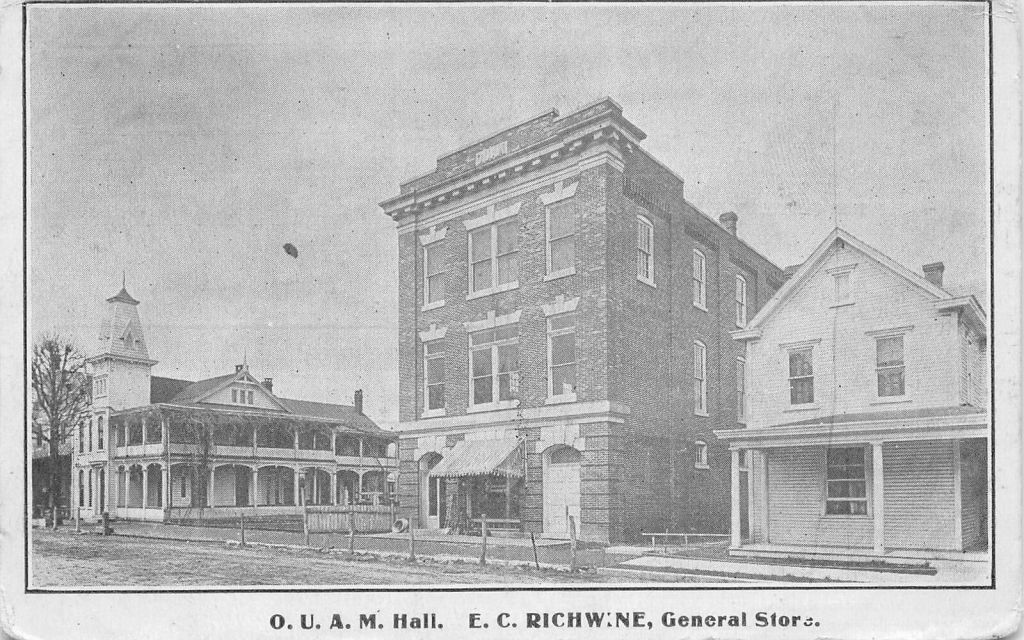
Historic 3rd Street Landmark Soon To Be Just A Memory …

This iconic 115-year-old three-story building on Third Street in the village of Boiling Springs, severely damaged by a deadly fire on February 4, 2020, is currently being dismantled brick by brick.

The building, constructed in 1906 at a cost of $7,000 ($203,453 in 2021 dollars) has over the years housed the local VFW, various stores, taverns, dance halls, and more recently apartments.

It was originally designed and built to be the centerpiece of the community and the home of the 50 member Boiling Springs Lodge of the Order of United American Mechanics (O.U.A.M.).

When built it housed a retail storeroom and an ‘election room’ on the first floor, a large room with a stage and dressing rooms designed for the village’s public entertainment events on the second floor, and a private ornate lodge room on the third floor.

The hall was formally dedicated and opened on Monday, January 14, 1907. The dedication services began at two o’clock in the afternoon with welcoming music followed by speeches by lodge members and Boiling Springs residents Milton Embick and John Fissel.

Following a choral selection, three of the organization’s statewide officers gave short addresses complimenting the Boiling Springs Lodge on its “fine new hall.” The formal dedication service, including the lodge rituals, was conducted by a national officer of the Order.

A parade through the village which had been planned for that evening had to be cancelled due to inclement weather. Instead, well attended public services were held in the hall at 7:30.

The Boiling Springs O.U.A.M. Lodge was organized in 1867 with just eleven members. This dynamic new three-story brick building replaced the Order’s original wood lodge built in 1870, which was destroyed by fire in March of 1906.

Ironically, almost exactly 115 years later, it is fire that is responsible for the demise of this iconic piece of Boiling Springs history.

The Strange Demise of Alfred Jerome Rider, Jr

It was the wee hours of a cold, dark Saturday morning when three of Carlisle’s “East End” boys left Hanover PA headed home on Route 94. They had left Carlisle the day before, braving a light snowfall to drive the 30 miles to Hanover to visit friends. Only two of them would make it home alive.

* * *

One day last week I received a message from a young couple who are neighbors and friends. Both of our houses were built in 1882 as part of the Katherine Furnace complex in Boiling Springs. My friends were in the process of adding insulation to their attic and, as they were removing the 138-year-old floor boards, they discovered some interesting items secreted underneath.

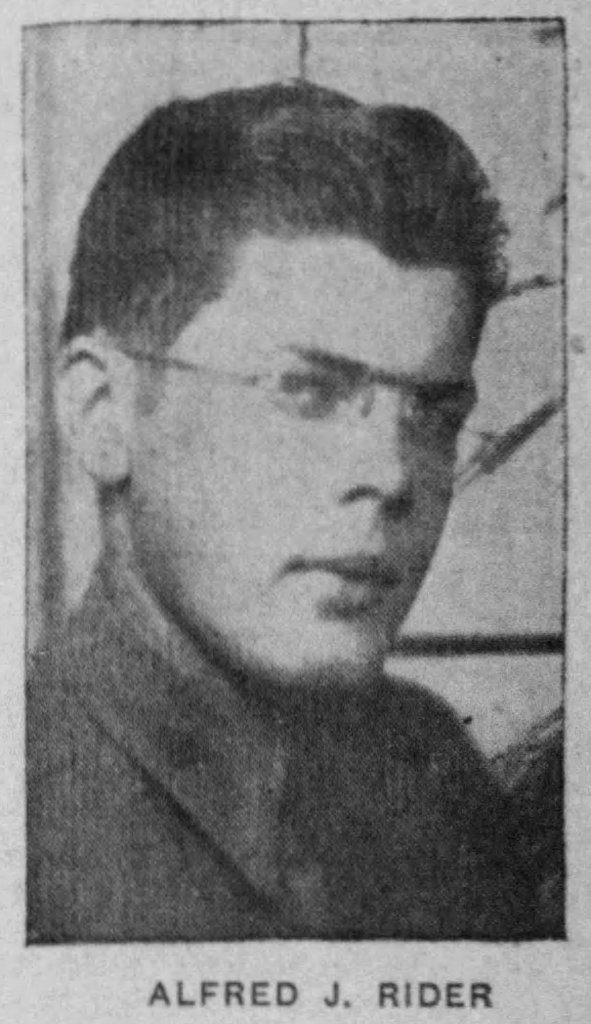
Among them was a picture clipped from a newspaper. No date … no story … just a picture with the name “Alfred J. Rider” under it. Knowing my passion for investigating the mysteries of history, they ended their message with “Curious who Alfred Rider was.”

With my curiosity piqued, I couldn’t resist heading down history’s highway one more time. What I discovered raises as many questions as it does answers.

November 30, 1940 …

It was the wee hours of a cold, dark Saturday morning when three of Carlisle’s “East End” boys left Hanover PA headed home on Route 94. They had left Carlisle the day before, braving a light snowfall to drive the 30 miles to Hanover to visit friends. Only two of them would make it home alive.

* * *

In 1940 Carlisle’s industrial “East End” was a rough and tumble neighborhood that housed a mix of working-class and middle-class families. On its northeast edge was a U.S. Army base known as the Carlisle Barracks. From the town’s earliest beginnings, tanneries, distilleries and breweries were built along the Letort Spring run which ran through this section of town. The combination of alcohol, women, soldiers, and young local men with time to kill sometimes led to violent events.

Alfred Jerome Rider Jr., the youngest of the three party-goers, was a twenty-year-old employee of the Carlisle Shoe Factory. Like many young men of the time, Al left school at the end of ninth grade. He was living with his parents at 21 North East Street and would often walk the several blocks to work with his father who was also employed at the same factory.

Kenneth George Stringfellow, a twenty-eight-year-old neighbor and co-worker of Alfred, was the oldest. Ken was five feet eleven inches tall and weighed 160 pounds. He lived with his mother Nellie at 145 South East Street. Ken’s last year of school was also the ninth grade. He had been arrested in August 1938 for driving his boat recklessly among the swimmers and other small craft on the Conodoguinet Creek at the Cave Hill park. He paid a $15 fine (about $275 today) and costs.

The third young man was twenty-two-year-old John Glaize Snyder Jr. who worked as a carpenter for Masland Carpets. The five foot ten inch 210-pound lad lived with his widowed mother at 200 East Pomfret street. His father, John Sr., proprietor of The Early Printery, had died two years earlier at the age of 43 from a heart attack and bronchial pneumonia. Young John, who played the saxophone, was the only one of the three who had graduated from High School.

The Story …

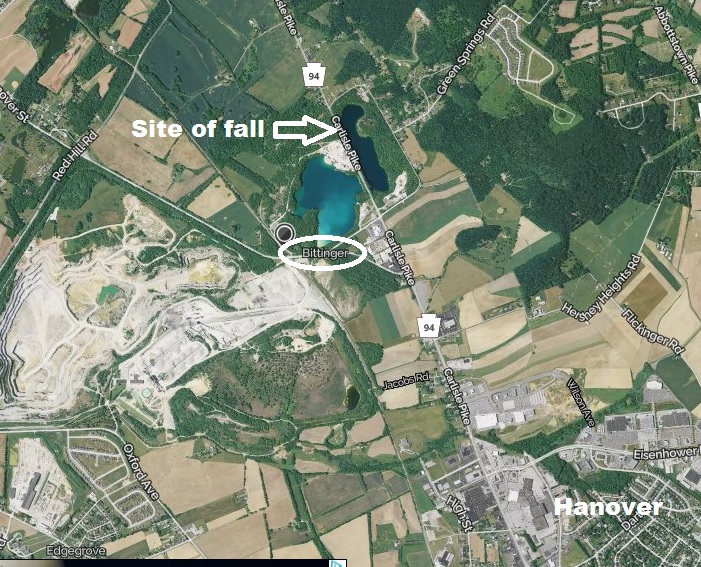
According to John Snyder and Ken Stringfellow’s account, Al was driving the car that fateful night. About 2:20 am, shortly after they left and just a few miles north of Hanover, Al complained of feeling ill and pulled the car off the side of the road near a small village called Bittinger. They said he got out, climbed a small embankment, and disappeared into the darkness.

After waiting in the warmth of the car for what seemed like an eternity with neither sight or sound of their friend, John and Kenneth became concerned and began to call out for Al. Hearing no response, the two said they grabbed a flashlight from the car and headed into the night to search for their young friend.

Location of incident

After climbing the embankment and walking a short distance into the trees they said they stumbled upon, and nearly fell into, a deep limestone quarry owned and operated by Bethlehem Steel Company. Fearing that their friend had fallen into the pit, they climbed the eighty feet to the bottom of the cliff where they discovered Alfred’s crumpled and broken body in a heap.

John and Kenneth located and notified the quarry’s night watchman, Roy Jacoby. Roy called two Bethlehem Steel employees who lived in Hanover as well as the Hanover ambulance. The group of men carefully retrieved Alfred’s mangled body, carried it to the top of the quarry, and loaded it into the ambulance which took him to the Hanover General Hospital.

Al struggled valiantly to live, but finally succumbed to his injuries at 6:15 pm Saturday evening. The official cause of death was listed as a ruptured bladder, internal injuries, hemorrhaging, and fractured pelvis and femur. He had bruises over his entire body. The York County coroner. L.U. Zech, issued a certificate of “accidental” death.

Alfred’s body was returned to Carlisle by the W.J. Ewing estate funeral home where services were held at 2 o’clock on December 3rd,. The pastor of Al’s church, the First Church of God’s Reverend J.E. Strine officiated, and Alfred was buried in the Westminster Cemetery. Five of his pallbearers were members of his church. One of them, Marlin Stine, was my father’s cousin – my first cousin once removed.

Curiosities …

Why was Alfred J. Rider’s picture hidden underneath an attic floor board in a house on Race Street in Boiling Springs? At the time of his death, the home was owned by a 75-year-old widow named Louisa (Neidigh) Foose who lived with her 42-year-old unmarried daughter Margaret and a young couple who roomed with them.

Louisa was the widow of John Wesley Foose and the daughter of John and Catherine Neidigh. She was a member of the United Brethren Church. She had two daughters in addition to Margaret, Mrs. Ethel (John) Yohe and Mrs. Jerry A. Brunner, both of Carlisle; a son Jacob, of Boiling Springs; two sisters, Mina Sheaffer of Boiling Springs and another relative of mine, Mrs George Hurley of Newville.

I discovered no connections between Alfred Rider and Louisa Foose, her family or her roomers. The roomers were 25-year-old George O’Hara, his 17-year-old bride Dorothy Anna Mentzer, and their 5-month-old son George Jr. The couple had married on February 9th of that year.

Was the tattered shoe found in the attic related to this incident or was it there as part of an old superstitious practice of hiding shoes under boards to ward off evil spirits?

Pennsylvania’s State Motor Police reportedly conducted an investigation into the death after Snyder and Stringfellow reported that there were no guard rails or fences around the quarry which they said was dangerously close to the highway. Perhaps the police should have inquired more deeply into the cause and circumstances of Alfred’s death?

We may never know the full story surrounding the death, or why Alfred’s picture was hidden under floor boards in the attic of a home in Boiling Springs. If you have any information that could shed light on these people and mysteries, please feel free to share them in the comments section below.

Our Village’s 175th Anniversary

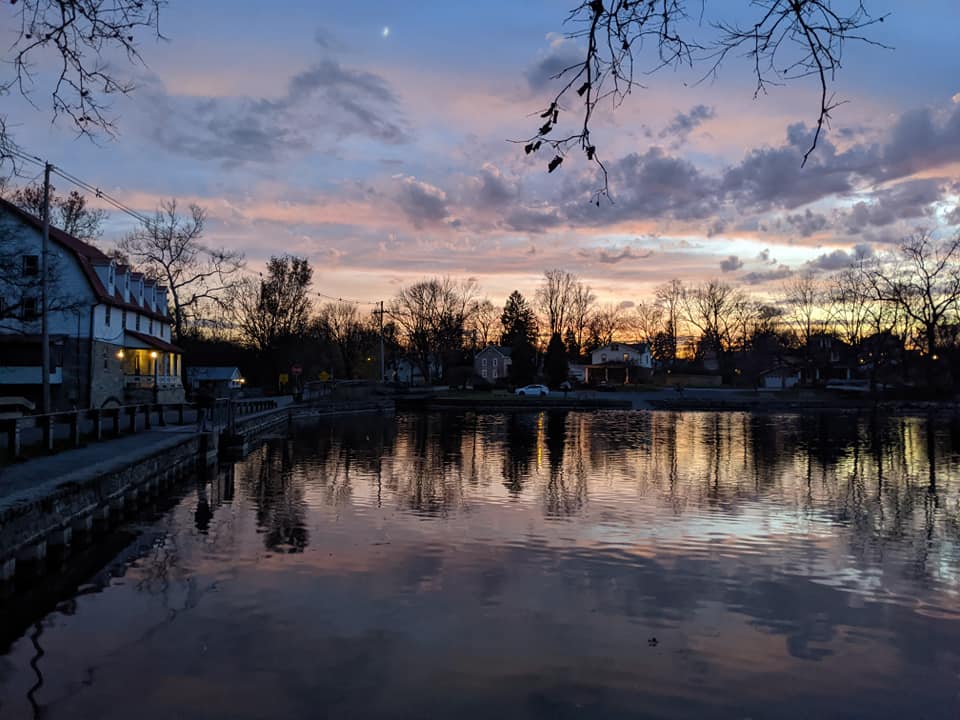
Last week our little village repeated what has become a treasured annual tradition on the first Sunday evening in December for more than a quarter century … the lighting of the Christmas tree on Children’s Lake.

Like much of the rest of the year, complicated by the highly contagious Covid-19 pandemic, this year’s annual event was ‘Covidifferent’. No crowds. No ceremonies. No brass band. No hot chocolate or caroling. No wide-eyed children peering anxiously into the night darkness over the lake to catch the first glimpse of Santa arriving in his boat.

As I reflected on this year’s many modified or canceled events, I was reminded that nearly lost in all the confusion and changes has been the 175th anniversary of the birth of our historic Norman Rockwell-esque village.

In the Beginning …

It was the fall of 1845 when 27-year-old Daniel Kaufman hired a young surveyor who lived nearby to lay out several streets and building lots for a village on land he had purchased from his father two years earlier.

Daniel’s land was located on the southwest corner of an intersection of two well-traveled dirt roads and extended southward along the road leading to the Carlisle Iron Works. On the east side of that road laid a small lake created in 1762 to power the furnace and forge at the Iron Works. It was on that intersection at the north end of the lake that the village’s first lots and streets were surveyed and plotted by Adam Leidich. Sadly, no copy of the original survey plan is known to exist today.

In 1830 Frederick Brechbill built a stone farmhouse, wood barn and other outbuildings on the northwest corner of that intersection (where the “Lakeside Mart” and “Sugar Shack” are located today). Prior to that time the only building known to be near the spring was a small, brick church believed to have been built in 1794.

In 1832 Peter Brechbill, Frederick’s son, erected a building across the road from his father’s house and applied for a license to “keep a public house” and tavern. That building still stands today and is known as the “Boiling Springs Tavern”.

The one event that transpired in our village’s history in calendar year 1845 was the survey made by Adam Leidich. It was during the next 365 days that the first four lots were sold and the first building was erected in the village. That building is also still standing and is the home of Caffé 101.

The Best Laid Plans

Beginning with Richard Tritt, our village’s resident historian, several community members envisioned 2020 to be a year with events that would recognize and commemorate this 175th milestone.

Township Supervisor Duff Manweiler noted the significance of the year in the township’s 2020 winter/spring newsletter when he highlighted the village’s many annual events and “hoped that the ‘Boiling Springs 175’ theme” would be adopted by the events’ organizers.

In anticipation of the occasion I began working on a series of short stories covering events and people that were part of our community’s early years. Then, just when you think you have it all figured out, the Universe throws a pandemic into the mix. Oh Lord, the best laid plans …

“But Mouse, you are not alone,
in proving foresight may be vain:
The best laid schemes of mice and men
Go oft awry.”

– Robert Burns, 1785

Looking forward … 175+

The coming 2021 calendar year will be a challenging one for the Village of Boiling Springs as Children’s Lake is drained and the dam wall in front of the mill apartments is reconstructed. Changes in the traffic flow and improvements on First and Front streets are also in the plans.

On the positive side, there are encouraging signs that the pandemic will slowly become less of a threat, especially with the introduction of the first vaccine this week … and the second one on the immediate horizon.

It is my hope that our community will find a way to continue to honor the 175th Anniversary of our village during the spring and summer months of 2021. After all, a year is a year is a year. 12 months. 52 weeks. 365 days.

Happy Anniversary Boiling Springs.

Gypsies, Tramps and Thieves … The Great Boiling Springs Bank Robbery

A Day at the Lake: Tuesday, August 9, 1927

While the entire “Summer of ‘27” proved to be a fascinating time in the village, August 9th would end up as one of the most memorable days in its history. Prohibition, which had outlawed the manufacture (but not the consumption) of alcohol, was at its peak and the new music and fashions of the “Roaring Twenties” had begun to appear at the popular summer resort park and its dances.

Before the season started manager Harry Markley had instituted some major improvements to the lakeside park property and its buildings, and Gilbert Malcolm’s new 150 x 60 foot lighted and heated public swimming pool, which opened on July 2nd, quickly became the park’s most popular attraction.

This particular Tuesday in August began with the regular throngs of cheerful visitors arriving in eager anticipation of enjoying a day at the resort lake and park. Some came by the trolley, some came by motor coach. Among those who traveled to town that morning by auto were two gypsy women.

It is not known if there was a nearby carnival or fair that brought the women to the area, but it is known is that gypsies often entertained at those events with their music, singing and dancing. Gypsy women also were known to work carnivals and fairs telling fortunes.

Early in the day the two gypsy women entered Carey Kuhn’s general store which faced the lake on the south east corner of Front and Second streets. After inquiring about the price of watermelon, the two offered to tell Carey’s fortune. Mr Kuhn, whose wife had died just eight weeks earlier, wanted nothing to do with it and ordered the two women out of his store.

One short block up the street, overlooking the lake and park from its high vantage point at Third and Front Streets, sat the Boiling Springs State Bank. The bank had first opened for business five years earlier on Monday, November 27th, 1922. The two story, 28 x 38 foot building was built by Hemminger Brothers, general contractors from Carlisle, for $17, 867.62. (Roughly $268,000 in 2018 dollars).

Around two-thirty on this hot and steamy August afternoon, a car pulled up and parked in front of the native blue limestone bank. Two olive skinned black haired gypsy women, both dressed in brightly colored light chiffon sari-like skirts and tight low-cut v-neck blouses, emerged. Bright scarves, necklaces made of coins, and large ear rings adorned their bodies.

As they stepped through the doors into the well lighted five year old bank, they encountered cool air, tall ceilings, bright windows and dark mahogany woodwork. Mr. George Clayton Strickler, the 51 year old cashier and one of the bank’s directors, was alone in the bank except for his nine year old daughter Gladys and her friend Helen Carl.

The two gypsy women first asked for $2.50 gold pieces. Being told the bank had none of the coins, the women then offered to tell Clayton’s fortune. Like Carey Kuhn before him, Mr. Strickler declined and ordered the women to leave. This is when things got interesting.

One of the women asked for a coin bag, which Mr. Strickler provided. The other woman then pulled out a nickle and insisted on paying him for the bag, but Strickler refused. Rubbing the nickle for “luck”, she forced her way through a swinging door and stepped behind the cashier’s counter. As Strickler ordered her from behind the counter the other woman, who had remained in the room in front of the counter, managed to distract him.

At that point the woman behind the counter opened the cash drawer and placed the “lucky” nickel inside. The two women then left the bank, entered their car, and drove away. About twenty minutes later, when counting the cash drawer, Clayton Strickler discovered $410 in $5, $20 and $50 bills (nearly $6,000 in 2018 dollars) was missing. He immediately notified the police in all the surrounding communities.

Carlisle’s police chief C. Ross Trimmer notified the Pennsylvania State Police and then spent nearly all night and most of Wednesday morning in pursuit of the thieves. He somehow obtained the vehicle’s licence number and traced the vehicle into York County and back to Lemoyne in Cumberland County where he lost track of it.

Over the next several weeks numerous groups of gypsies were stopped and detained in Mechanicsburg, Carlisle and Gettysburg, but none could be positively identified by Clayton Strickler as the bank robbers. On August 25th both Strickler and Thelma Kuhn, daughter of Carey Kuhn, thought they recognized one woman in a group of gypsies detained in Carlisle, but apparently the gypsies had an alibi for August 9th as they were being held in custody by the police in Elwood City near Pittsburgh.

To this day, in spite of the valiant efforts of the police and the dogged determination of G. Clayton Strickler to locate the gypsy thieves, no one has ever been convicted for the bank robbery, nor has any of the missing money ever been recovered.

The Boiling Springs State Bank opened for business the next morning as usual and was never robbed again. It continued in business until noon on Saturday, December 17, 1938 when it closed it’s doors (as a bank) for the last time.

Friendly Ghosts at Childrens Lake?

Yes, my friends, the rumors of ghosts at Childrens Lake are real. According to folklore several apparitions have appeared at the lake. And not just at Halloween.

Looking to shed some light on this ghostly mystery, I recently took off on another of my road trips down history’s highway. Or perhaps I should say a road trip “on the trail of the Ghosts of Childrens Lake.”

There is one I found particularly fascinating. Legend has it that the shadowy soul or spirit of a young woman has been sighted at the lake numerous times over the years. Not a haunting or ghoulish ghost, but more just a slight whisper of white … a silent visitor wandering the waters edge.

I’m told that she’s affectionately nicknamed “The Nightwalker” since she has only been seen at night. She has been sighted walking along the lake and sometimes stopping to sit on a bench. Those who claim to have seen her have said that she appears to be looking for, or waiting for, someone.

Who might this mysterious manifestation be? Why does her spirit keep returning to walk the paths along the lake? Perhaps our ghost might be the spirit of a spurned maiden, rejected by a beau who used to walk down “lovers lane” with her during the lively heydays when the summer resort park thrived here.

Or perhaps our ghost is the spirit of Ivy Urich, a twenty three year old mother from Harrisburg, who brought her two young children to this popular lakeside park on June 29, 1910.

The annual Sunday school picnic in the park for members of the Park Street and Harris Street United Evangelical congregations had a well earned reputation as a fun filled event. More than 100 people had registered in eager anticipation of spending a delightful day in the park.

The trolley line offered reduced rates for picnickers, and special cars had been reserved and were waiting for the group at the Capitol City’s Market Square. Ivy and her children, four year old Dorothy and two year old Harold, woke up early that morning. The trolley was leaving at 8:00 for the two hour ride across the river and up through the beautiful Cumberland Valley and they didn’t want to be late. Her disappointed husband Charles had to remain behind in the city because it was a work day.

After they arrived at the lake and everyone retrieved their picnic basket from the trolley line’s “basket car”, the morning was busy with socializing and children’s games. A leisurely lunch was followed by a brief but necessary business meeting, and the afternoon was filled with lively competitive contests for prizes.

While Ivy was helping with the afternoon activities, her children were playing with others nearby. Around three o’clock Ivy realized that she had not seen Harold for about ten minutes and asked Dorothy where he was. When her daughter said she didn’t know, Ivy began a frantic search.

Harold had been last seen playing near the dance pavilion so she headed in that direction. In the worst possible scenario for any parent, she discovered his unconscious body floating face down in the lake near a tree just behind the pavilion.

The young lad was pulled from the water as a large crowd began to gather. A medical student and Dr. H. F. Gross, who had accompanied the group from Harrisburg, as well as Dr. M. R. Peters from Boiling Springs, worked for more than two hours to try and revive Harold. Their efforts were unsuccessful.

Harold Urich’s heartbroken and grief stricken mother was placed under medical care. His father, who had received word of the accident, arrived in Boiling Springs on the 6:10 trolley. Harold’s tiny lifeless body was returned home to Harrisburg by train and buried a few days later.

This was not the first time a young child is known to have faced death in the lake.

Twenty-two years earlier the two year old son of Boiling Springs resident Thomas Sweeney fell into the head race near the iron furnace office. A clerk in the office named L. K. Weller, hearing the screams of several women, plunged into the four foot deep water and pulled the child to safety. Thomas had already gone under the water twice and surely would have died had it not been for the women’s screams and Mr. Weller’s quick action.

Perhaps our ghost is the sad spirit of the recently widowed Myrtle Whitcomb, who lived on Second Street in the village.

On Saturday, May 21, 1932, six year old Raymond Harold Whitcomb went to the lake fishing with several of his local friends. Around three o’clock in the afternoon he and Roy Lutz, seven-year-old son of local businessman Milt Lutz, had moved to the bank of the intake water to the turbine in Jared C. Bucher’s Boiling Springs Electric Company building.

According to his friend, Raymond got too close to the edge, lost his balance, and fell into the water. The swift current pulled him under the water instantly. Immediately Roy ran to, and alerted, a gentleman named Lawrence Strickler who was nearby washing his car.

Lawrence Strickler was a thirty-four year old Army veteran of World War I. He was employed as a finance clerk at the Carlisle Barracks and, with his wife Nellie Wilson, had an three year old son of his own named Paul.

Strickler immediately raced to the power plant. By the time he got there two other men named Jonas Rupp and Albert Skelly had also arrived. As the men searched for the youngster, the power plant was shut down and the gates of the dam were opened to drain the water from the intake. After roughly one half hour the young man was spotted lying in the remaining water at the bottom of the ten or twelve foot deep intake.

A ladder was quickly lowered into the water. Mr. Strickler climbed down and, with the assistance of Mr. Rupp and Mr. Skelly, removed Raymond’s body. Lawrence Strickler rushed the young man to Dr. Gamble’s nearby office, and then to the Carlisle Hospital where he was declared dead on arrival. Mrs. Gordon Whitcomb, forty year old mother of four, whose husband had died six years earlier, had just lost her only son.

Perhaps the mysterious “Ghost of Childrens Lake” is neither a spurned maiden nor one of these grieving mothers. Perhaps she is just a shimmer of mist drifting up from the water on a chilly night.

Or perhaps … just perhaps, she is a guardian angel sent to watch over the water and protect the children who still come to the lake each day … to feed the ducks and fish and play.

[Copyright 2018]