* * *
One day last week I received a message from a young couple who are neighbors and friends. Both of our houses were built in 1882 as part of the Katherine Furnace complex in Boiling Springs. My friends were in the process of adding insulation to their attic and, as they were removing the 138-year-old floor boards, they discovered some interesting items secreted underneath.
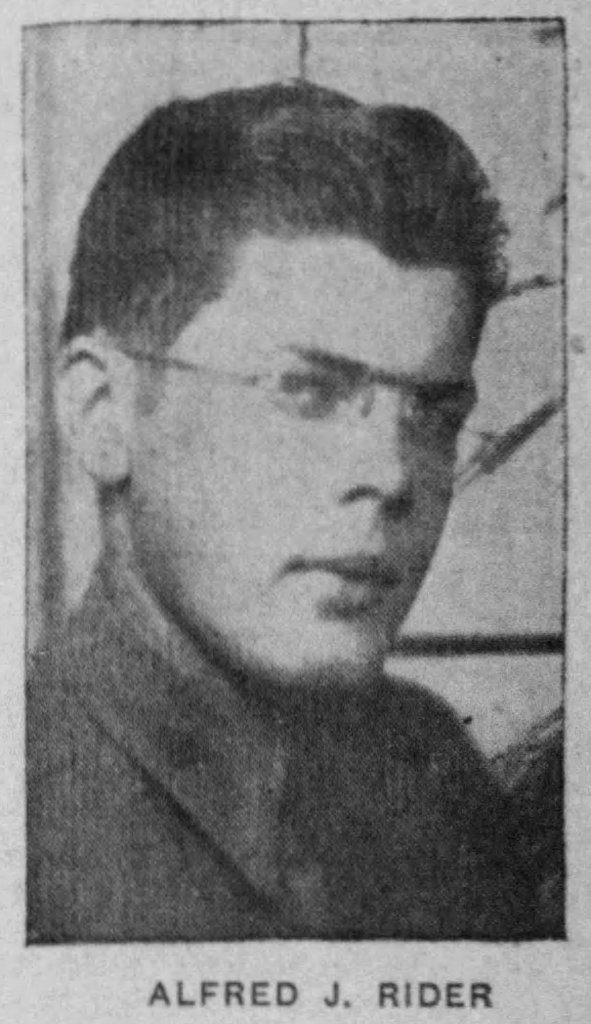
Among them was a picture clipped from a newspaper. No date … no story … just a picture with the name “Alfred J. Rider” under it. Knowing my passion for investigating the mysteries of history, they ended their message with “Curious who Alfred Rider was.”
With my curiosity piqued, I couldn’t resist heading down history’s highway one more time. What I discovered raises as many questions as it does answers.
November 30, 1940 …
It was the wee hours of a cold, dark Saturday morning when three of Carlisle’s “East End” boys left Hanover PA headed home on Route 94. They had left Carlisle the day before, braving a light snowfall to drive the 30 miles to Hanover to visit friends. Only two of them would make it home alive.
* * *
In 1940 Carlisle’s industrial “East End” was a rough and tumble neighborhood that housed a mix of working-class and middle-class families. On its northeast edge was a U.S. Army base known as the Carlisle Barracks. From the town’s earliest beginnings, tanneries, distilleries and breweries were built along the Letort Spring run which ran through this section of town. The combination of alcohol, women, soldiers, and young local men with time to kill sometimes led to violent events.
Alfred Jerome Rider Jr., the youngest of the three party-goers, was a twenty-year-old employee of the Carlisle Shoe Factory. Like many young men of the time, Al left school at the end of ninth grade. He was living with his parents at 21 North East Street and would often walk the several blocks to work with his father who was also employed at the same factory.
Kenneth George Stringfellow, a twenty-eight-year-old neighbor and co-worker of Alfred, was the oldest. Ken was five feet eleven inches tall and weighed 160 pounds. He lived with his mother Nellie at 145 South East Street. Ken’s last year of school was also the ninth grade. He had been arrested in August 1938 for driving his boat recklessly among the swimmers and other small craft on the Conodoguinet Creek at the Cave Hill park. He paid a $15 fine (about $275 today) and costs.
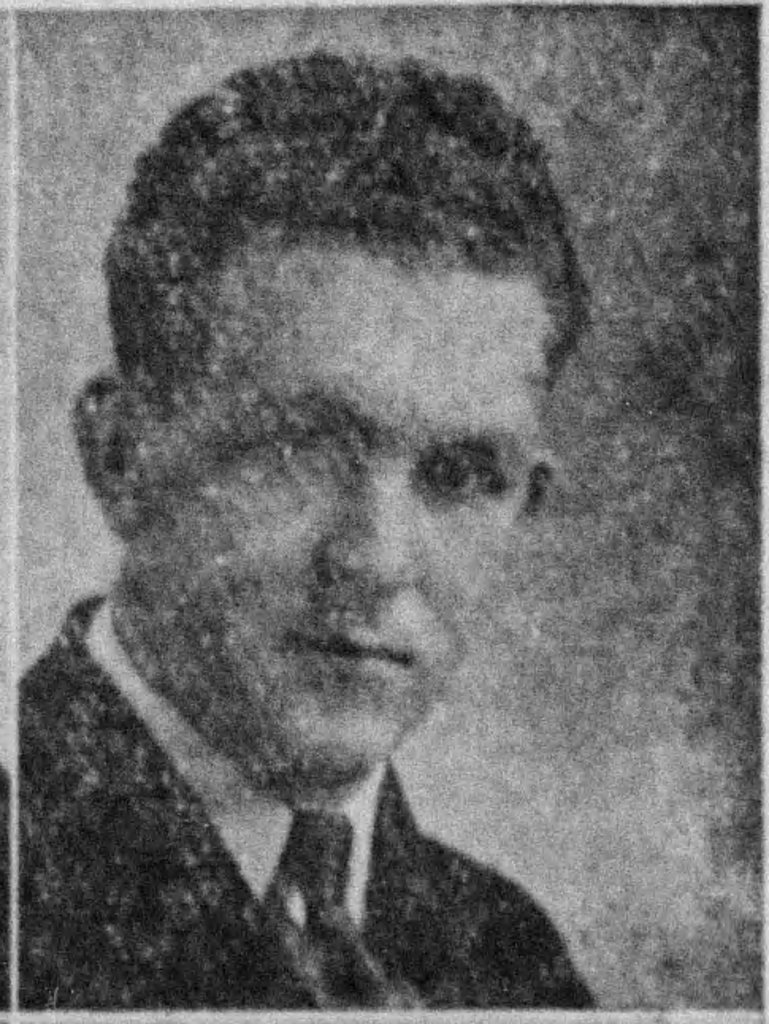
The third young man was twenty-two-year-old John Glaize Snyder Jr. who worked as a carpenter for Masland Carpets. The five foot ten inch 210-pound lad lived with his widowed mother at 200 East Pomfret street. His father, John Sr., proprietor of The Early Printery, had died two years earlier at the age of 43 from a heart attack and bronchial pneumonia. Young John, who played the saxophone, was the only one of the three who had graduated from High School.
The Story …
According to John Snyder and Ken Stringfellow’s account, Al was driving the car that fateful night. About 2:20 am, shortly after they left and just a few miles north of Hanover, Al complained of feeling ill and pulled the car off the side of the road near a small village called Bittinger. They said he got out, climbed a small embankment, and disappeared into the darkness.
After waiting in the warmth of the car for what seemed like an eternity with neither sight or sound of their friend, John and Kenneth became concerned and began to call out for Al. Hearing no response, the two said they grabbed a flashlight from the car and headed into the night to search for their young friend.
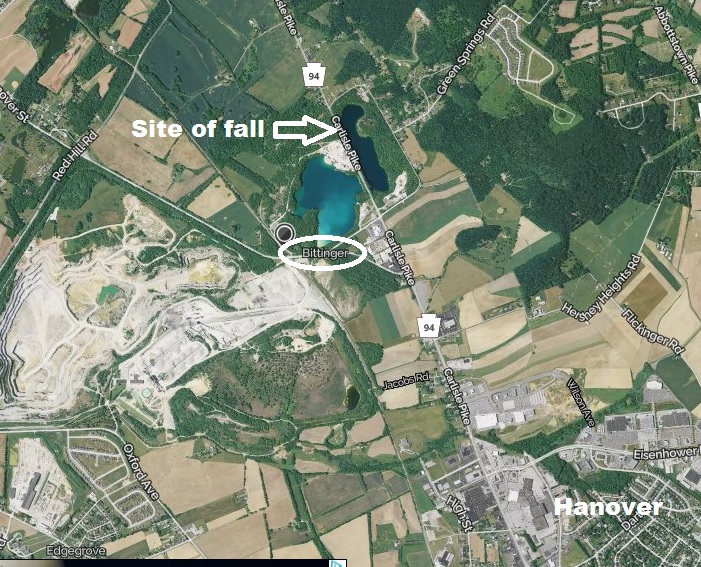
After climbing the embankment and walking a short distance into the trees they said they stumbled upon, and nearly fell into, a deep limestone quarry owned and operated by Bethlehem Steel Company. Fearing that their friend had fallen into the pit, they climbed the eighty feet to the bottom of the cliff where they discovered Alfred’s crumpled and broken body in a heap.
John and Kenneth located and notified the quarry’s night watchman, Roy Jacoby. Roy called two Bethlehem Steel employees who lived in Hanover as well as the Hanover ambulance. The group of men carefully retrieved Alfred’s mangled body, carried it to the top of the quarry, and loaded it into the ambulance which took him to the Hanover General Hospital.
Al struggled valiantly to live, but finally succumbed to his injuries at 6:15 pm Saturday evening. The official cause of death was listed as a ruptured bladder, internal injuries, hemorrhaging, and fractured pelvis and femur. He had bruises over his entire body. The York County coroner. L.U. Zech, issued a certificate of “accidental” death.
Alfred’s body was returned to Carlisle by the W.J. Ewing estate funeral home where services were held at 2 o’clock on December 3rd,. The pastor of Al’s church, the First Church of God’s Reverend J.E. Strine officiated, and Alfred was buried in the Westminster Cemetery. Five of his pallbearers were members of his church. One of them, Marlin Stine, was my father’s cousin – my first cousin once removed.
Curiosities …
Why was Alfred J. Rider’s picture hidden underneath an attic floor board in a house on Race Street in Boiling Springs? At the time of his death, the home was owned by a 75-year-old widow named Louisa (Neidigh) Foose who lived with her 42-year-old unmarried daughter Margaret and a young couple who roomed with them.
Louisa was the widow of John Wesley Foose and the daughter of John and Catherine Neidigh. She was a member of the United Brethren Church. She had two daughters in addition to Margaret, Mrs. Ethel (John) Yohe and Mrs. Jerry A. Brunner, both of Carlisle; a son Jacob, of Boiling Springs; two sisters, Mina Sheaffer of Boiling Springs and another relative of mine, Mrs George Hurley of Newville.
I discovered no connections between Alfred Rider and Louisa Foose, her family or her roomers. The roomers were 25-year-old George O’Hara, his 17-year-old bride Dorothy Anna Mentzer, and their 5-month-old son George Jr. The couple had married on February 9th of that year.
Was the tattered shoe found in the attic related to this incident or was it there as part of an old superstitious practice of hiding shoes under boards to ward off evil spirits?
Pennsylvania’s State Motor Police reportedly conducted an investigation into the death after Snyder and Stringfellow reported that there were no guard rails or fences around the quarry which they said was dangerously close to the highway. Perhaps the police should have inquired more deeply into the cause and circumstances of Alfred’s death?
We may never know the full story surrounding the death, or why Alfred’s picture was hidden under floor boards in the attic of a home in Boiling Springs. If you have any information that could shed light on these people and mysteries, please feel free to share them in the comments section below.

 d.s.miller, writer
I loved this Dave. Keep it up.
LikeLiked by 1 person