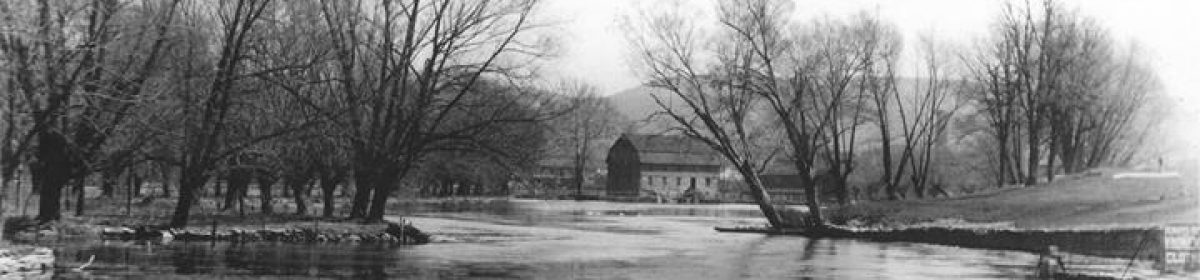

A Day at the Lake: Tuesday, August 9, 1927
While the entire “Summer of ‘27” proved to be a fascinating time in the village, August 9th would end up as one of the most memorable days in its history. Prohibition, which had outlawed the manufacture (but not the consumption) of alcohol, was at its peak and the new music and fashions of the “Roaring Twenties” had begun to appear at the popular summer resort park and its dances.

Before the season started manager Harry Markley had instituted some major improvements to the lakeside park property and its buildings, and Gilbert Malcolm’s new 150 x 60 foot lighted and heated public swimming pool, which opened on July 2nd, quickly became the park’s most popular attraction.
This particular Tuesday in August began with the regular throngs of cheerful visitors arriving in eager anticipation of enjoying a day at the resort lake and park. Some came by the trolley, some came by motor coach. Among those who traveled to town that morning by auto were two gypsy women.
It is not known if there was a nearby carnival or fair that brought the women to the area, but it is known is that gypsies often entertained at those events with their music, singing and dancing. Gypsy women also were known to work carnivals and fairs telling fortunes.
Early in the day the two gypsy women entered Carey Kuhn’s general store which faced the lake on the south east corner of Front and Second streets. After inquiring about the price of watermelon, the two offered to tell Carey’s fortune. Mr Kuhn, whose wife had died just eight weeks earlier, wanted nothing to do with it and ordered the two women out of his store.

One short block up the street, overlooking the lake and park from its high vantage point at Third and Front Streets, sat the Boiling Springs State Bank. The bank had first opened for business five years earlier on Monday, November 27th, 1922. The two story, 28 x 38 foot building was built by Hemminger Brothers, general contractors from Carlisle, for $17, 867.62. (Roughly $268,000 in 2018 dollars).
Around two-thirty on this hot and steamy August afternoon, a car pulled up and parked in front of the native blue limestone bank. Two olive skinned black haired gypsy women, both dressed in brightly colored light chiffon sari-like skirts and tight low-cut v-neck blouses, emerged. Bright scarves, necklaces made of coins, and large ear rings adorned their bodies.
As they stepped through the doors into the well lighted five year old bank, they encountered cool air, tall ceilings, bright windows and dark mahogany woodwork. Mr. George Clayton Strickler, the 51 year old cashier and one of the bank’s directors, was alone in the bank except for his nine year old daughter Gladys and her friend Helen Carl.

The two gypsy women first asked for $2.50 gold pieces. Being told the bank had none of the coins, the women then offered to tell Clayton’s fortune. Like Carey Kuhn before him, Mr. Strickler declined and ordered the women to leave. This is when things got interesting.
One of the women asked for a coin bag, which Mr. Strickler provided. The other woman then pulled out a nickle and insisted on paying him for the bag, but Strickler refused. Rubbing the nickle for “luck”, she forced her way through a swinging door and stepped behind the cashier’s counter. As Strickler ordered her from behind the counter the other woman, who had remained in the room in front of the counter, managed to distract him.
At that point the woman behind the counter opened the cash drawer and placed the “lucky” nickel inside. The two women then left the bank, entered their car, and drove away. About twenty minutes later, when counting the cash drawer, Clayton Strickler discovered $410 in $5, $20 and $50 bills (nearly $6,000 in 2018 dollars) was missing. He immediately notified the police in all the surrounding communities.
Carlisle’s police chief C. Ross Trimmer notified the Pennsylvania State Police and then spent nearly all night and most of Wednesday morning in pursuit of the thieves. He somehow obtained the vehicle’s licence number and traced the vehicle into York County and back to Lemoyne in Cumberland County where he lost track of it.
Over the next several weeks numerous groups of gypsies were stopped and detained in Mechanicsburg, Carlisle and Gettysburg, but none could be positively identified by Clayton Strickler as the bank robbers. On August 25th both Strickler and Thelma Kuhn, daughter of Carey Kuhn, thought they recognized one woman in a group of gypsies detained in Carlisle, but apparently the gypsies had an alibi for August 9th as they were being held in custody by the police in Elwood City near Pittsburgh.
To this day, in spite of the valiant efforts of the police and the dogged determination of G. Clayton Strickler to locate the gypsy thieves, no one has ever been convicted for the bank robbery, nor has any of the missing money ever been recovered.
The Boiling Springs State Bank opened for business the next morning as usual and was never robbed again. It continued in business until noon on Saturday, December 17, 1938 when it closed it’s doors (as a bank) for the last time.

 d.s.miller, writer